CygNet FMS History Graph Control
 The CygNet FMS History Graph Control is an ActiveX control used to view liquid (periodic) or gas metering/gas quality history graphically for multiple selected Nodes, in order to get a visual overview of the data and to facilitate the identification of trends and features on a larger scale. The History Graph can display data for up to 16 process variables at one time. Data cannot be edited with this control.
See Using the History Graph Control for more information about configuring and using this control.
See CxFmsHistoryGraphCtrl Object in the Scripting section for more information about scripting this control.
Adding a History Graph Control to a Screen
To Add and Configure a CygNet FMS History Graph Control in CygNet Studio
- Create a new CygNet Studio screen.
- Click the ActiveX tool
 on the Standard Tools palette.
- Click and drag the outline of a box on the screen. When the mouse button is released, an Insert OLE Control dialog box appears.
- In the dialog box, double-click on CygNet FMS History Graph Control to place a history Graph control on your screen.
- Right-click the control to open its property sheet.
- On the ActiveX page, click ... or double-click (OCXProperties) to access the CygNet FMS History Graph Control Properties dialog box.
- The CygNet FMS History Graph control contains a General tab, a Graph tab, a Colors tab, and a Commands tab.
- Configure properties on each page as desired, click Apply, and then click OK.
- Close the property sheet, save, and then switch to Run mode to use the control.
General Properties
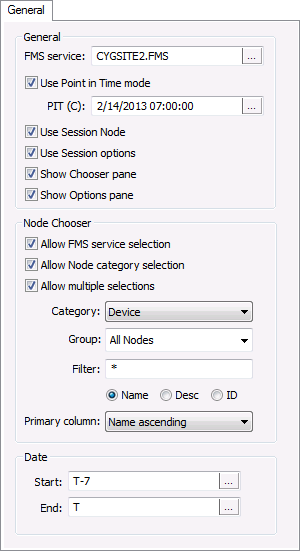
The General page of the CygNet FMS History Graph Control Properties dialog box contains the following properties. This control displays data in Contract time (C), therefore time format selection is not available in this control.
| General |
|
FMS service
|
Type the name of the Site.Service to which to connect in the control's Chooser, or click ... to access the Select Service dialog box.
|
|
Use Point in Time mode
|
Click the check box to select/clear the option to use the Point in Time mode.
|
|
PIT (C)
|
If Use Point in Time mode is selected, do one of the following.
- Type the desired date/time value into the text box.
- Click ... to access the Select Date and Time dialog box, then enter the date/time, in Contract time (C), from which you want to view data.
Default value is T, date and time today.
See Using the Home Menu for more information about PIT mode.
|
|
Use Session Node
|
Click the check box to select/clear the option to Use Session Node instead of using the Node chooser.
Default value is cleared.
|
|
Use Session options
|
Click the check box to select/clear the option to Use Session options instead of entering a time window and time format.
Default value is cleared.
|
|
Show Chooser pane
|
Click the check box to select/clear the option to display the Chooser pane in the control.
Default value is selected.
|
|
Show Options pane
|
Click the check box to select/clear the option to display the Options pane in the control.
Default value is selected.
|
| Node Chooser |
|
Allow FMS service selection
|
Click the check box to select/clear the option to show the FMS service selector in the control's Chooser.
|
|
Allow Node category selection
|
Click the check box to select/clear the option to show the Node category selector in the control's Chooser.
|
|
Allow multiple selections
|
Click to allow multiple selection of Nodes in the control's Chooser list.
|
|
Category
|
Select the desired Node Category to display in the control's Chooser from the drop-down menu.
Options are as follows.
|
|
Group
|
Select the desired Node Group type to display in the control's Chooser from the drop-down menu.
Options are as follows.
- All Nodes
- General
- Station
- By Category
|
|
Filter
|
Select a filter.
First type a partial string of known Node name/description/ID characters to populate the filter text box in the control's Chooser. Wildcard values * (multiple character) and ? (single character) are supported.
Default value is * (multiple character wildcard) - all.
Note: Wildcards can be used only when filtering by Name or Desc, not when filtering by ID.
Then select a Node option to filter for results.
Options are as follows.
|
|
Primary column
|
Select the desired primary sort column in the control's Chooser from the drop-down menu.
Options include the following
- Type ascending
- Name ascending
- Description ascending
- Type descending
- Name descending
- Description descending
Default value is Name ascending
|
| Date |
|
Start
|
Date selections are in Contract days (C).
Enter the starting date (absolute or relative date) in the text box or click ... to access the Select Date dialog box.
See Selecting Date and Time for more information.
|
|
End
|
Date selections are in Contract days (C).
Enter the ending date (absolute or relative date) in the text box or click ... to access the Select Date dialog box.
See Selecting Date and Time for more information.
|
See Using the History Graph Control for more information about configuring these properties.
Graph Properties
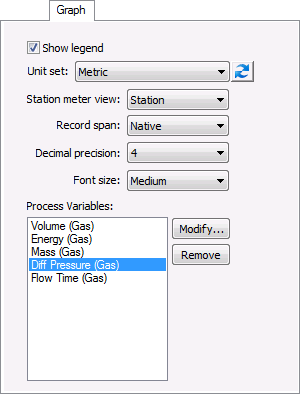
The Graph page of the CygNet FMS History Graph Control Properties dialog box contains the following properties.
|
Show legend
|
Click the check box to select/clear the option to display the color-coded device legend at the top of the graph.
|
|
Unit set
|
Select a Unit set in which to view the data.
Options appear in the drop-down menu, which is populated by the unit sets defined in the service, and includes a default unit set.
|
|

|
Refresh the available unit set list
|
|
Station meter view
|
Click to select a Station meter view mode from the drop-down menu.
Options are as follows.
|
|
Record span
|
Click to access the drop-down menu to select a Record span for display of history data.
Options are as follows.
Default value is Native.
|
|
Decimal precision
|
Click to select a Decimal precision for the display from the drop-down menu.
Options are from 0 - 7 decimal places.
Default value is 7.
Note: Although values are shown in the History Graph control with a decimal precision of up to 7 places, device Node values are shown in other controls with a decimal precision of up to 10 places, and in the Batch, Ticket, Liquid Device QTR, and Liquid Device Raw QTR reports with a decimal precision of 15 places.
|
|
Font size
|
Click to select a Font size from the drop-down menu.
Options are as follows.
Default value is Medium.
|
|
Process variables
|
Lists the process variables currently selected to be displayed in the graph.
Note: A maximum of 16 process variables can be contained in the list box, and displayed on the graph, at one time.
|
|
Modify
|
Click Modify to access the Process Variables dialog box containing the list of possible process variables that can be displayed in the graph.
Note: Attempting to add more than the maximum number of 16 process variables produces an error message.
|
|
Remove
|
Select the data item(s) to be removed from the graph, and then click Remove to delete the item(s) from the list of process variables that will be displayed graphically. To select multiple PVs to delete from the list, use Ctrl+Click or Shift+Click.
|
Selecting and Modifying Process Variables for Display
Select up to 16 process variables for display in the graph. Attempting to add more than the maximum number of process variables produces an error message. When a selected process variable has no data for the entire time window selected for the control, it will not appear on the graph or in the Value Table.
To Configure History Graph Process Variables for Display
The list of available process variables is subdivided into gas and liquid items for ease of selection. Modify the list as follows.
- On the Options pane, click Modify to access the Process Variables dialog box to select the process variables to display in the graph.
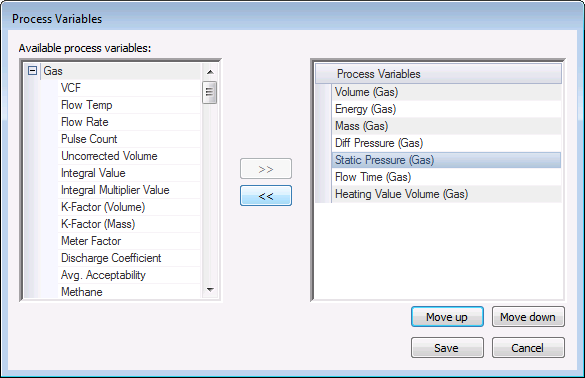
- Select the items to display.
- Click a process variable name from the list of available items (left pane), and then click >> and << to edit the list of process variables to display graphically (right pane).
- To select multiple PVs at one time, use Ctrl+Click or Shift+Click.
- Select the order of the items in the display.
- The order of items in the Process Variables list will be the order of display in the graph.
- To change the order, first click an item to select it in the list and then click Move up / Move down until the desired order is achieved. Each click moves the selected item one position further up/down the list.
- Save your selections.
- Once the list contains the desired items in the desired order, click Save to view the results in the process variables list shown on the Options pane.
See Using the History Graph Control for more information about configuring these properties.
Colors Properties
The Colors page of the CygNet FMS History Graph Control Properties dialog box contains the following properties.
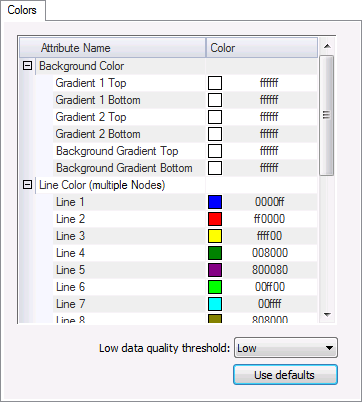
See Graph Color Properties for more information about configuring colors for the FMS History Graph control.
Commands Properties
The Commands page of the CygNet FMS History Graph Control Properties dialog box contains the following options.
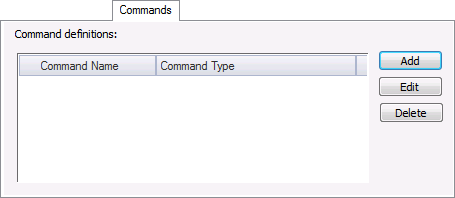
See Managing Node Commands for more information about configuring commands for the FMS History Graph control.
More:
 CygNet FMS History Graph Control – Properties, Methods, and Events


